7 May 2026 2 pm-6 pm CEST | online via Zoom
keynote: “Playing Steampunk London: Collective Memory and Transmedia Game Spaces“ by Dr Helena Esser
Neo-Victorian media embody our complex, dialectic relationship with the Victorian past: They manifest our collective memory of the past but also provide a staging ground for the (re-)evaluation of its legacies and (perceived) failures. At the same time, neo-Victorian expressions also expose the limits of our own imagination. Steampunk, I argue, with its retro-speculative, anachronistic, and meta-historical impulses, heightens that potential through adaptation and remix. In this talk, I examine how a collectively shared idea of ‘Victorian London’ arises out of a Victorian transmedia discourse that creates a palimpsestic urban mythology across various forms. From that shared memory, immensely popular video games such as Assassins’ Creed: Syndicate and The Order: 1886 (both 2015) construct virtual simulations of the Victorian city that externalise our reciprocal relationship with memory as interactive play. They tap into, translate, and reinforce a collectively curated memory of ‘Victorian London’ to create hyper-real simulacra in the form of spatialised models in which (game) space encodes – and potentially re-calibrates – our mental maps of city and past in tandem. As such, the virtual steampunk city not only externalises steampunk’s fundamentally participatory nature, or embodies the constant (re-)evaluation and (re-)adaptation of neo-Victorian memory, but also makes visible how steampunk collapses linear relationships between past and present in favour of a more volatile and multiple concept in which past and present continually invade, infuse, and shape one another.
Helena Esser holds a PhD from Birkbeck, London, and is a literary scholar working and publishing on steampunk, neo-Victorian, and Victorian popular fiction. Her monographs on Steampunk London (Bloomsbury) and Ouida (Edward Everett Root) were published in 2024. Her work on steampunk London, cyborgs, and video games, neo-Victorian adaptation, or Meiji Japan has been published, among others, in Humanities, Neo-Victorian Studies and Victorian Popular Fictions. She co-organises the VPFA reading group on ‘The Third Sex’ and has co-edited the latest special issue of Victorian Popular Fictions.
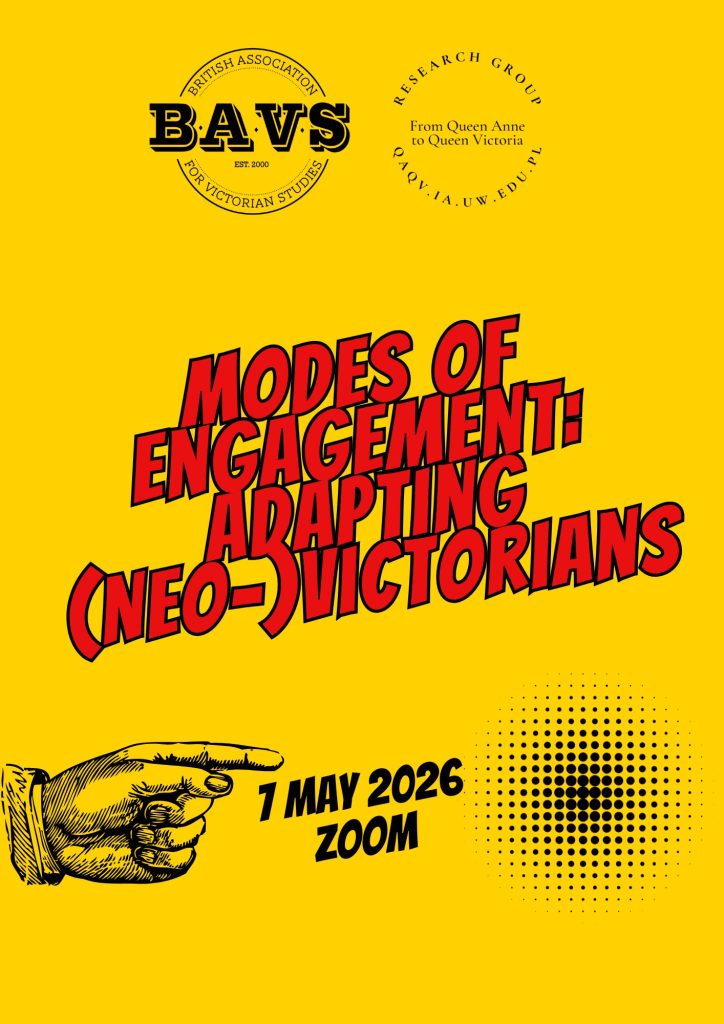
Paraphrasing Linda Hutcheon, the neo-Victorians have a habit of adapting just about everything – and in just about every possible direction. The stories of Victorian poems, novels, plays, operas, paintings, songs, dances, and tableaux vivants are constantly being adapted from one medium to another and then back again not only on film, television, radio, and digital or social media, but also theme parks, historical enactments, and virtual reality experiments. In this workshop, we would like to explore the interactions and connections between the different ways contemporary culture engages with the traces of the Victorian past as well as how these different genres or expressions interact.
We welcome papers exploring and investigating various intermedial connections. Possible topics include but are not limited to:
- Returns to and/or rewritings of Victorian cultural narratives across media
- Trends and developments in period/costume drama
- Steampunk cultures
- Re-adaptations/adaptations adapted
- Neo-Victorian game cultures (computer games, board games, etc.)
- Media including both images and text, including neo-Victorian manga, comics and graphic novels
- Performance, theatre and the theatrical
- Everyday encounters with the (neo-)Victorian
Important dates:
15 March 2026 deadline for a 250‒word abstract and a 100-word biographical note via this form
by 23 March 2026 notifications of acceptance
by 30 April 2026 submission of complete workshop papers [up to 5 000 words, excluding Works Cited] to be shared with other presenters
For questions, reach out to the organisers at qaqv@uw.edu.pl
Convenors: Dr Daný van Dam (BAVS, Leiden University) & Dr Lucyna Krawczyk-Żywko (QAQV, University of Warsaw)