text by Maria Szafrańska-Chmielarz
Nowadays, Singapore is mostly known as one of the Asian Tigers – a modern economic power that inspires awe with its futuristic buildings and clean streets. Singapore’s history, however, is much more complex and marked by colonialism, occupation, immigration and inequality. As a member of QAQV who got a chance to visit the city, I found myself not only eagerly learning everything I could but also noting down all the instances of the Victorian past that I came across. The list below is not exhaustive in the slightest, but it might highlight Singapore’s place in the postcolonial discourse regarding British imperialism all the same.
Singapore became a British port and then a colony at the beginning of the 19th century, with Thomas Stamford Bingley Raffles (1781-1826) taking Singapore as a British territory in 1819. Although Raffles was not a frequent guest in Singapore, he is still referred to as one of Singapore’s founding fathers. The British influence in Singapore is a complicated matter. It made the first steps to give the Singaporeans their own laws and protection they granted, but it also gave the infamous Section 377, which was abolished as late as 2022. Physical traces of Victorian Britain can also still be observed in contemporary Singapore, and that’s what I shall focus on in this post.
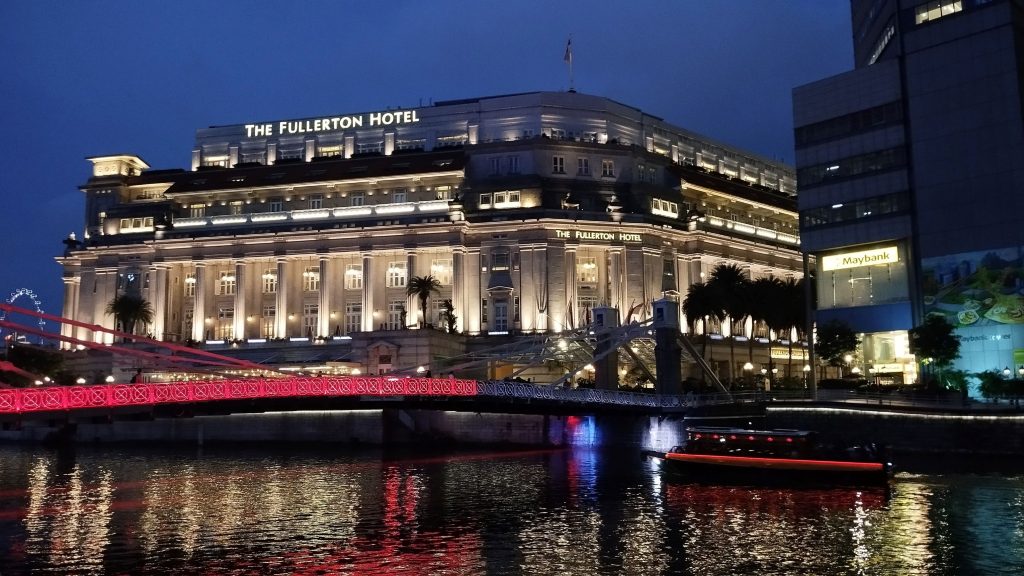
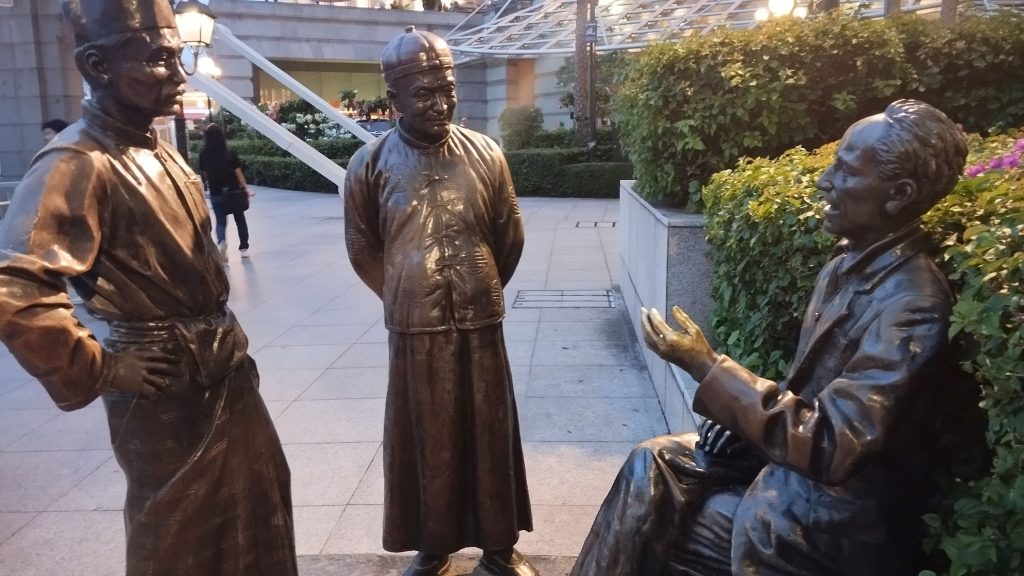
Walking along the river in Marina Bay, there is a chance to see the Cavenagh Bridge, finished in 1869 and named after Governor Sir William Orefur Cavenagh. The bridge is the oldest surviving one in Singapore. Right in front of it, there are 2003 sculptures made by Aw Tee Hong, depicting a typical scene of the market trade – the gentleman sitting comfortably like the all-wise Solomon waiting to share his wisdom is a Scotsman, Alexander Laurie Johnston, who in 1837 was one of the founding members of Singapore’s Chamber of Commerce and became its first chairman.
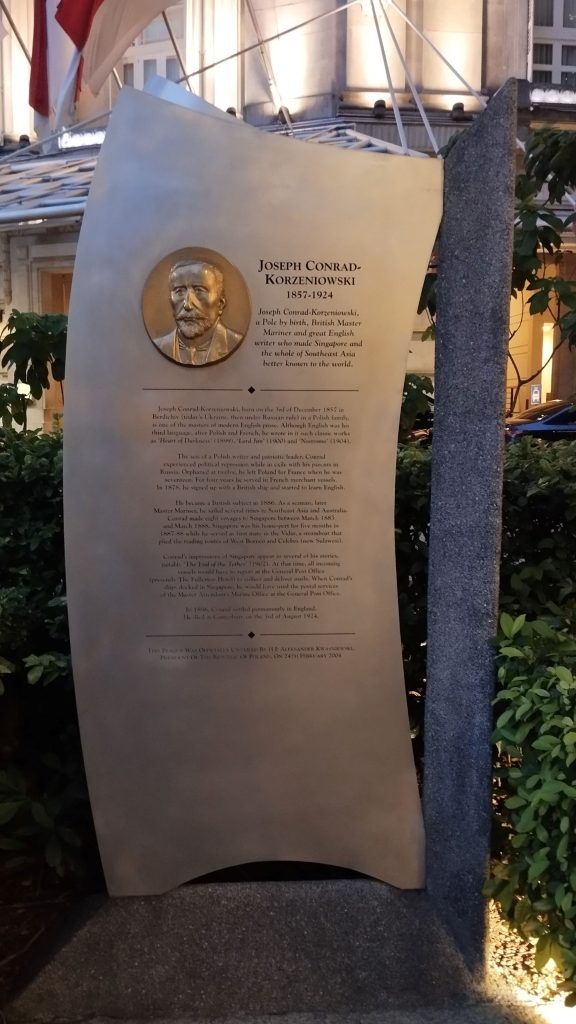
Not far from the sculptures, there is a favourite of every Polish tourist in any country they visit – a “Poland mentioned” plaque. This one is devoted to Joseph Conrad, a Polish-British writer who, as a steamship’s crew member, visited Singapore frequently enough in the 1880s for it to make an impression. Singapore appears in Conrad’s End of Tether (1902) and The Shadow-Line (1917), which were published together by the National University of Singapore Press as Tales of an Eastern Port: The Singapore Novellas of Joseph Conrad (2023).
However, one of the most globally famous parts of Victorian inheritance in Singapore is the Botanic Gardens. Founded in 1859 (in its current location), they became crucial in the rubber trade in 1888, with the arrival of Henry Ridley, a “brilliant botanist” and a “rubber evangelist” (Tan 35) who had foreseen the potential of rubber usage and thus devoted himself to research and cultivation of this plant. ‘Mad Ridley,’ as the botanist was sometimes called, made the Malaya peninsula into the main center of rubber production and export. Currently, the Gardens are mostly known for their hybrid orchids, which can be viewed for an additional price – while the entrance to the Gardens is free, the exhibitions require a ticket. Interestingly, pedestrians enjoying a walk in the Gardens might run into roosters and rather large lizards completely for free.

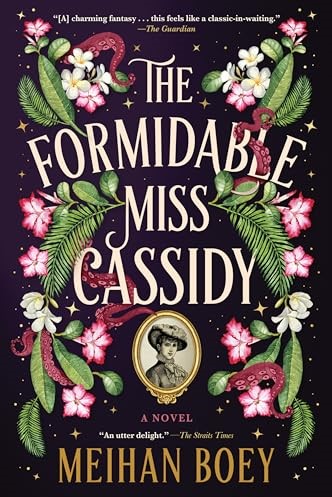
These are only a few examples of the vast legacy of Victorian Britain that can be found in Singapore, and only on the visual level. While Singapore is now an independent, complex nation in its own right, there are still parts of the Victorian past that the country needs to negotiate with, challenge, or dismantle. That is also the reason why Singapore authors start to embrace the Neo-Victorian mode of engagement with the past. One of the recent examples of that is Meihan Boey’s s The Formidable Miss Cassidy series, which follows a Scottish governess’s supernatural and whodunit adventures in 19th-century Singapore. Hopefully, more Singaporean voices will join soon, enriching the Neo-Victoriana with their own stories – there is certainly plenty to explore and write about.
Works Cited
Tan, Alvin. Singapore. A Very Short History. From Tamasek to Tomorrow. Talisman, 2022.