text by Lucyna Krawczyk-Żywko
A few months ago, I told a group of students I didn’t understand the hate the latest adaptation of Wuthering Hights received. I don’t think I was prepared for the reaction. A few weeks later some of them were disappointed with The Bride! and I stared waiting for an opportunity to write this post.
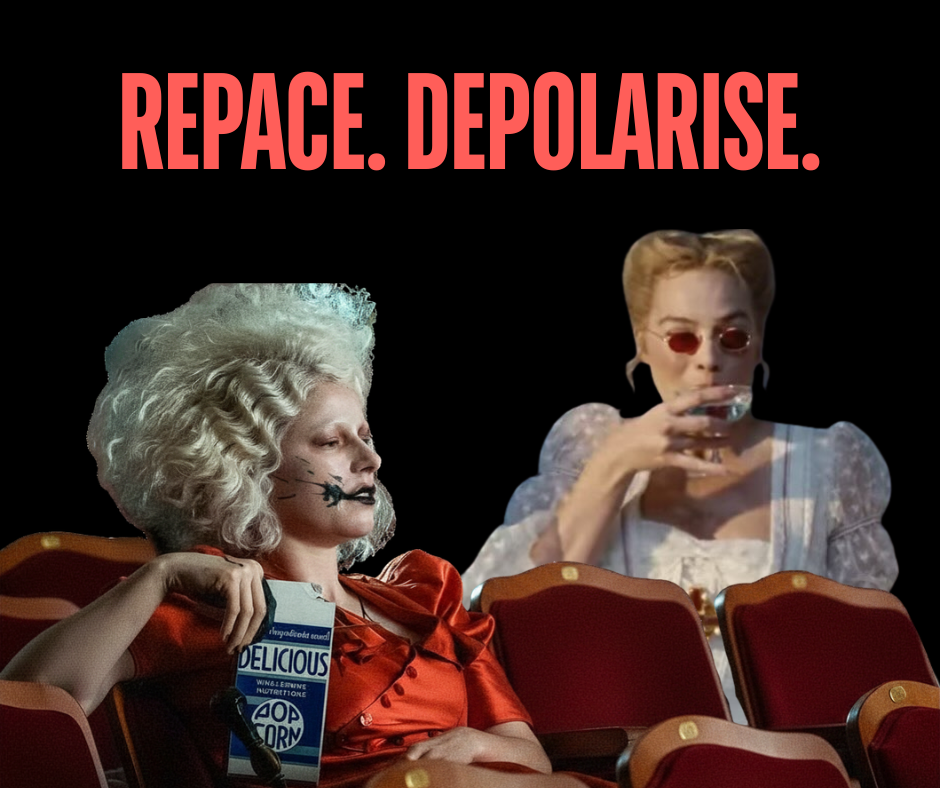
Emerald Fennell offers a teenage girl’s point of view on a classic novel and is criticised. Guillermo del Toro inserts his childhood traumas into another classic story and audiences accept it. It is because he gave audiences a typical del Toro’s ‘monster’ and she an unexpected version of a much-loved classic? Is posing the question ‘Would we have hated Wuthering Heights as much if a man had made it?’ (Wolfe) too farfetched?
Synecdoche on Steroids
Emerald Fennell’s ‘apparent massacre of Emily Brontë’s magnum opus’ was announced on the basis of the film trailer (Brown) and it seems many people enjoyed hating it (Mabey). Such rhetoric continued over the next 5 months, signalling that some critics, readers, and scholars forgot that at its source is a piece of advertising – trailers advertise films but also reflect ‘the decade’s dominant marketing trends’ (LaFrance). And the power of (false) advertising revealed itself also in the date of the premiere, as the Valentine’s Day overshadowed the toxicity present at the forefront of Emily Brontë’s novel (see Anderson).
Maggie Gyllenhaal’s The Bride! premiered on a weekend preceding International Women’s Day that no one seems to have noted. What was noted and variously assessed was its feminist approach (see, e.g., Hicks or Jones). What was largely overlooked was its engagement with the era that produced The Bride of Frankenstein (1935), including the (indirect) Ida Lupino reference.
Fast Criticism
When I said in class that even though I do not agree with Fennell’s narrative choices, I think her adaptation is true to the spirit of the novel, the group froze in disbelief. Their dominant opinion was that the director got it all wrong, that she missed the point, et cetera. One of the first questions I asked in return was when was the last time they read Bronte’s text (based on my own responses to the novel – first when I was 16 and then 40+), and the answers varied. Still, the underlying theme was Fennell’s departure from the source.
One of the things I keep telling students is that fidelity criticism takes them nowhere. It may serve fans or reviewers but being based on comparison and evaluation, it rarely leads to interesting conclusions. Moreover, it tends to be aimed not in favour of the source text but against the creators of the adaptation for a simple reason: they dare to offer a point of view that departs from a given reader’s version of the source. What it offers is a comfort of judgement and a fast opinion, which may increase the clickability of a review or a social media post. And what if we slowed down? What if we gave ourselves some time to think? What if we refrained from passing judgements under the pressure of time? Not to mention: what if we posed more meaningful questions?
Fidelity was not a problem in the case of Maggie Gyllenhaal’s retelling of a largely non-existent character of the companion of the creature aka Frank, but her depiction of the author of Frankenstein did raise some eyebrows along with ignoring its comment on the question of authorship. What also posed an apparent problem was its approach to genres and conventions, praised and criticised, though not in an equal measure. So how about not assuming ‘it is too chaotic and makes no sense’ and spending some time pondering its ‘disobedient geometry’, as Dr Euphorius describes her work to the titular character (see also Wickings)?
‘If you are not with me, then you are my enemy’
Since I am hardly present on social media but work with students who are digital natives, I am always curious about their perspectives on the ways in which social media shape communication and interpretation of facts and fictions. What has recently come to the fore is how tired they are of various polarising forces within fandoms and gaming communities. Bubbles shape discourse and, apparently, expressing a dissenting voice may come at a price. We may bemoan the decline of online exchanges but our effort should be directed elsewhere: to (re)create safe space for in-class debate that changes the pace of discussions and depolarises opinions. Thus, I ended up suggesting a separate discussion on Wuthering Heights for those who were interested – after all, the course was on adapting Frankenstein.
Embracing the discomfort
No one truly benefits from fast criticism, and when the trailer phase was over and audiences had some time to (re)think their first reactions to the actual film, other voices started to appear: that Fennell’s ‘work loves to push boundaries, to make statements, to get people talking’ (Baugher), or that it is a ‘deliciously, unapologetically an Emerald Fennell film’ (Minassian). After all, the pleasure of adaptation stems from repetition without replication, with a difference or variation (Hutcheon) and experiencing a work of art is not about our comfort.
The apparently uncomfortable cinematic experience of following the plot of The Bride! clashes with dissenting positive opinions criticising critics (see, e.g., Meriweather, Thomas)
Last week I did a talk for secondary school students on unfaithful adaptations. Afterwards, one of the teachers said she may finally get down to watch Emerald Fennell’s movie. I wonder what her reaction will be and whether she will keep up the momentum and watch The Bride! as well.
References
Anderson, Hephzibah. 2018. ‘Heathcliff and literature’s greatest love story are toxic.’ www.bbc.com/culture/article/20180725-heathcliff-and-literatures-greatest-love-story-are-toxic.
Baugher, Lacy. 2026. ‘Whatever You Think of “Wuthering Heights,” We Need More Filmmakers Like Emerald Fennell.’ www.rogerebert.com/women-writers-week/whatever-you-think-of-wuthering-heights-we-need-more-filmmakers-like-emerald-fennell.
Brown, Lara. 2025. ‘What has Hollywood done to Wuthering Heights?’ spectator.com/article/what-has-hollywood-done-to-wuthering-heights/.
Hicks, Luke. 2026. ‘The Bride! is a bold, bloody, feminist Frankenstein freakout.’ www.avclub.com/the-bride-review.
Jones, Rendy. 2026. ‘‘The Bride!’ Review: Maggie Gyllenhaal’s Stylish Monster Movie is a Chaotic, Half-Formed Feminist ‘Joker’.’ www.rendyreviews.com/movie-reviews/the-bride-review.
LaFrance, Adrienne. 2014. ‘Why Classis Movies Have Terrible Trailers.’ www.theatlantic.com/entertainment/archive/2014/01/why-classic-movies-have-terrible-trailers/283332/.
Mabey, Claire. 2025. ‘Everyone hates the new Wuthering Heights trailer, and here’s why.’ thespinoff.co.nz/books/09-09-2025/everyone-hates-the-new-wuthering-heights-trailer-and-heres-why.
Meriweather, Meecham Whitson. 2026. ‘Critics Want You To Think The Bride Is Bad, But I Would Prefer Not To.’ meechammeriweather.substack.com/p/the-bride-review.
Minassian, Liana. 2026. ‘Review: ‘Wuthering Heights’ Is Dividing Viewers – and We Need to Talk About It.’ theeverygirl.com/emerald-fennell-wuthering-heights-review/.
Thomas, Ande. 2026. ‘The Critics are Wrong: Long Live ‘The Bride!’ [Movie Review].’ www.whatsleepsbeneath.com/archive/the-bride-2026.
Wickings, Rob. 2026. ‘Disobedient Geometry – metafiction, multiverse and The Bride!’ excusesandhalftruths.com/2026/03/14/disobedient-geometry-metafiction-multiverse-and-the-bride/.
Wolfe, Y.L. 2026. ‘I Think We Owe Emerald Fennell an Apology.’ yaelwolfe.medium.com/i-think-we-owe-emerald-fennell-an-apology-17327db4064c.