text by Maria Szafrańska-Chmielarz
The world of anime is full of references to and adaptations of other cultures, with Victorian culture among the most recurring themes. Be it the aesthetics of Gothic Lolita, the mix of novels and urban legends such as Kuroshitsuji (2008-2009), or an original story set in Victorian Britain like Emma: A Victorian Romance (2005), the elements of Victoriana appear frequently in both fantasy and slice-of-life settings presented in anime form. It has to be acknowledged that it is very common for the references to British culture to be very superficial. Borrowing the term from Castello and Scilabra, a vast number of references are limited to being “western potpourri”:
Japanese animated productions show how the Western world is perceived as a monolithic entity: a potpourri made of colosseums, Walt Disney, the Marvel universe, the Grimm brothers and Christianity, where everything is taken out of its context and merged together. (Castello and Scilabra 193)
This monolithic approach to Western culture might be seen as a reason to dismiss countless Western-inspired anime as superficial engagement with British culture, without any particular meaning behind it. Yet, there are instances where the Western potpourri is paired with an interesting commentary on cultural works, as is the case with Fate/Apocrypha (2017).
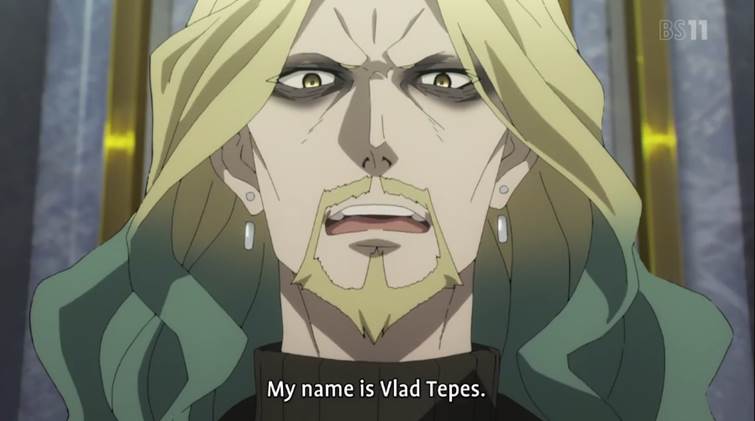
Fate/Apocrypha belongs to an ever-growing franchise started by the visual novel Fate/Stay Night (2004), which mixed ancient Greek heroes, King Arthur, and the epic of Gilgamesh, among others, to tell a story of historical characters being summoned to modernity to fight for the Holy Grail. Very popular in Japan, it has since then inspired visual novels, multiple anime series, manga, and games, including Fate Grand Order, which remains to this day one of the most successful mobile games worldwide. By the balance of humorous references and in-depth analysis of the nature of the heroic journey as a concept universal for all cultures, the Fate universe, despite being a good example of a Western potpourri, offers a space for post-colonial commentary – the representation of Vlad III, most commonly known as Dracula, is one of the subjects of such commentary.
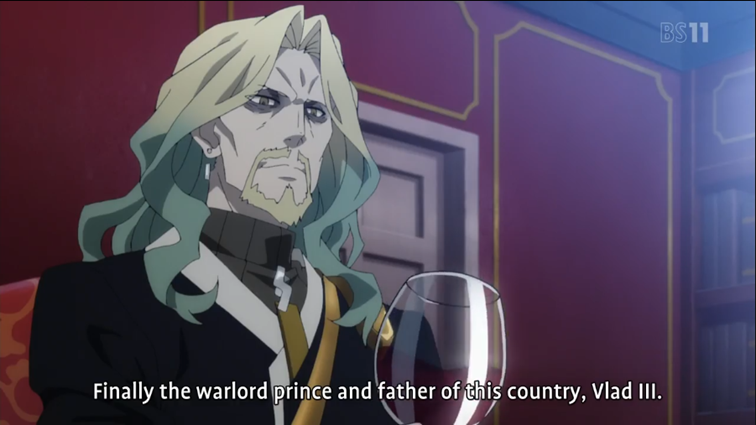
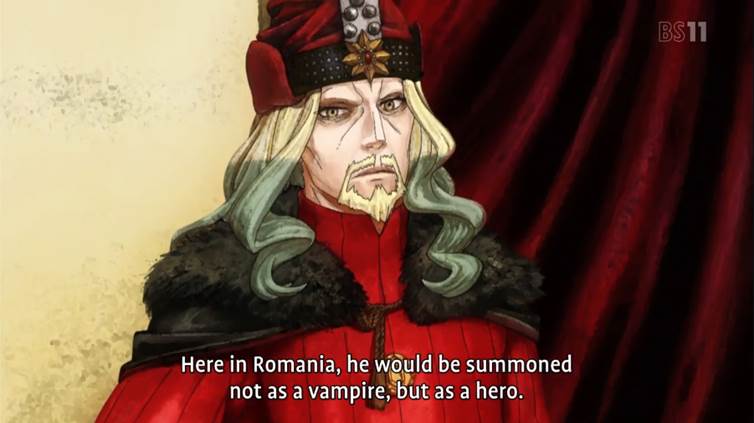
To take part in the Holy Grail War, a spirit from the past needs to have a wish they want granted, a longing strong enough to answer the call of the Mages trying to summon them. Vlad III desires to remove Bram Stoker’s Dracula from existence, for it changed the memory of him not only in his own land but worldwide. Instead of being remembered as the hero who protected Romania, his identity was overwritten by a British author, and determined the shape of the cultural memory of Vlad Tepes for even his own nation. Dracula, tapping into the fear of the Other coming to the British Empire and corrupting it with Eastern ideas, takes a Romanian historical figure and twists his memory, a national symbol, to weave its own narrative. In Apocrypha, the entire fight for the Holy Grail takes place on Romanian soil, with Vlad III being the strongest here, as a former king of this land and its people. And yet, ultimately, his wish is not realized: his Master, the Mage who summoned him, orders him to become a vampire, to embrace Stoker’s novel, for this way – by accepting the British imagination of him, he will be stronger. Despite being on Romanian soil, the power of the king turns out to be weaker than the fiction of the vampire. In the end, Vlad III goes berserk and as a frenzied vampire, has to be defeated by his own companions.
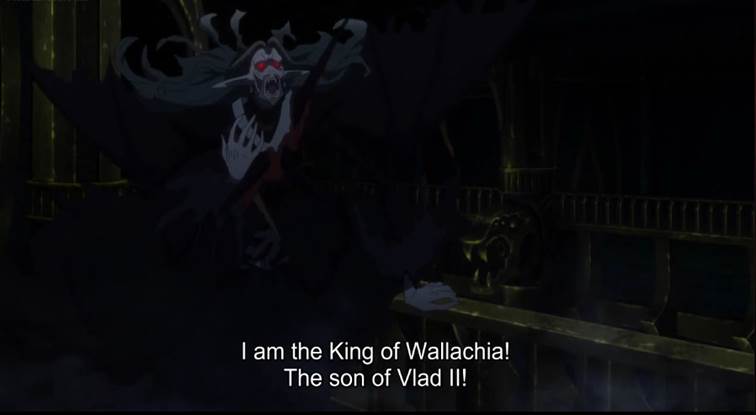
While Fate/Apocrypha features more characters associated with Victorian Britain – Jack the Ripper and Frankenstein’s monster (here: a woman), as well as other heroes from Western culture (Mordred), it is Dracula’s plea that holds the most potential when it comes to postcolonial discussions of the consequences of imperialism and cultural hegemony. After all, Romania was never conquered by the British Empire, and yet, a Victorian novel was powerful enough to appropriate Vlad Tepes and change him from a Romanian hero into a British monster. That is not to say that Fate/Apocrypha is a bona fide adaptation of Dracula; it is rather the case that the Western potpourri, despite its limitations and frequent shallowness, is simultaneously an indication of what elements of Western culture are commonly recognised and thus referenced. Analysing them and their various forms enables observing Western concepts through a new prism, highlighting their complexity, as is the case with the British enforcement of Vlad III’s fate.
Works Cited
Asai, Yoshiyuki and Higashide,Yūichirō, creators. Fate/Apocrypha. A1 Pictures, 2017.
Castello, Maria G. and Carla Scilabra. “Theoi Becoming Kami: Classical Mythology in the Anime World.” Ancient Magic and the Supernatural in the Modern Visual and Performing Arts, Bloomsbury, London, 2015, pp. 176–196.