text by Agnieszka Sienkiewicz-Charlish
In 1727, an elderly woman named Janet Horne was executed in the Scottish Highlands for the crime of witchcraft. Nearly three centuries later, her story still lingers – fragmented, uncertain, and filtered through rumor rather than record. In The Last Witch of Scotland (2023), novelist Philip Paris revisits this haunting episode not to sensationalize it but to ask a deeper question: what happens when history erases women’s voices, and how might storytelling restore them?
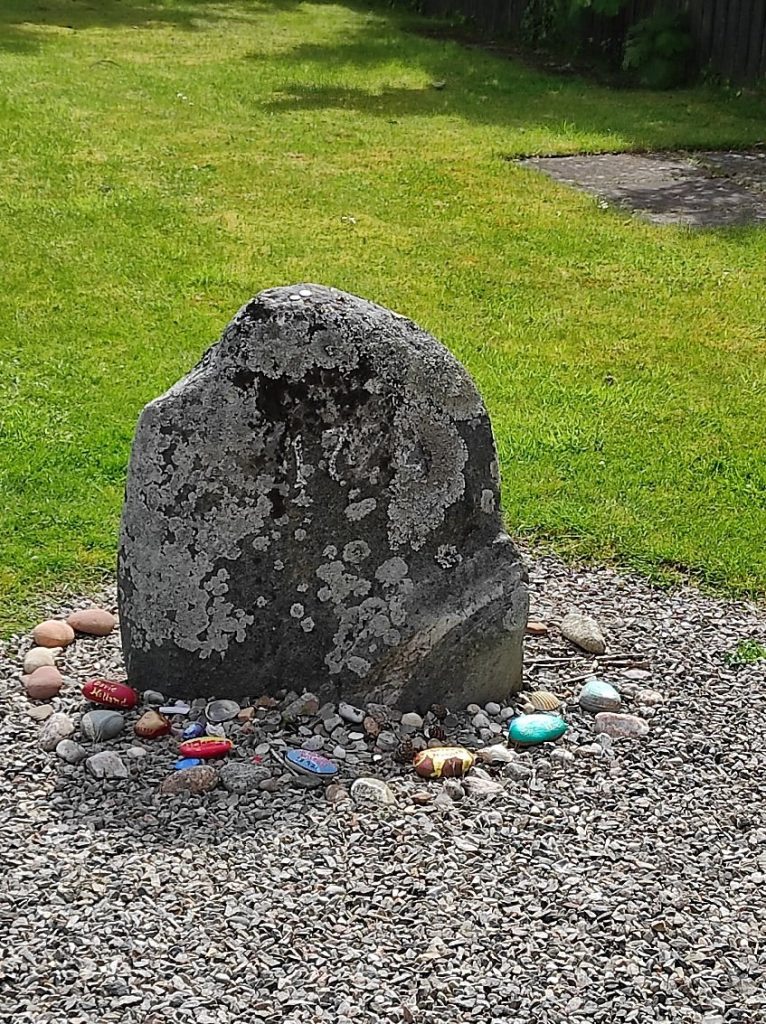
When visiting Dornoch you can visit the so-called “Witch’s Stone” which marks the spot
where Janet Horne met her tragic fate. There is no information on when the stone was erected,
or by whom and the date on the stone – 1722 – is generally accepted to be a mistake [photo: ASC].
Janet Horne was an old woman who lived together with her daughter in Kintradwell, in the Sutherland parish of Loth, about twenty miles north of Dornoch in the Highlands of Scotland. The daughter had a deformity in one of her hands (some sources say hands and feet). Her superstitious neighbours thought that the deformities resembled the hooves of a pony and accused Janet Horne of being a witch and of changing her daughter into a pony so that she could ride around the countryside carrying out the Devil’s work. The deformed hand was supposed to be a proof that one night Janet failed to change her daughter back to human form. Both women were arrested for witchcraft and put in the old Tolbooth in Dornoch. The daughter managed to escape, but Janet was found guilty of witchcraft and sentenced to death (Munro 11; Hook 33-34). In A History of the Royal Borough of Dornoch Michael Hook thus describes Janet’s execution:
Tradition has it that her execution took place on a dreich, bitterly cold early spring day in 1727. […] The poor old woman was stripped, tarred and feathered, and paraded about the town on the back of a cart as a warning to others never to follow her evil path. When she arrived at the side where she was supposed to be burned, Janet was said to have warmed her hands at the fire that was shortly to consume her, delighted by the warmth it offered on such a cold morning. This was a harmless old woman suffering from some form of advanced dementia, clearly completely unaware of where she was or what was about to happen to her. (34)
There appears to be no concrete evidence whether she was burned alive or strangled first – “wirreit at the stake” (the latter was the usual practice in Scotland). There are no surviving kirk session records for the parish of Loth for that part of the 1720s and no court records regarding the case itself. Although The Survey of Scottish Witchcraft [1] contains a record for “Janet Horne” there is some uncertainty about the name of the person who was executed as ‘Jenny Horne’ was a generic term for a witch in early eighteenth-century Scotland (Paris, Author’s Notes, 335).
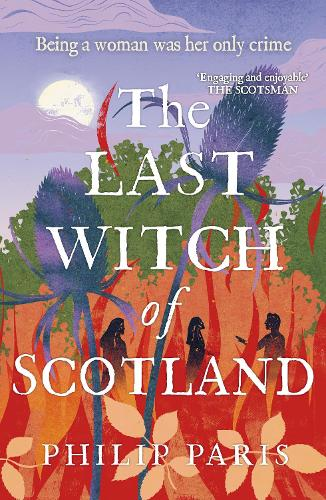
Thus, like so many victims of the witch trials, Janet’s voice is absent from the archive. She survives only as a name attached to a sentence of death. Paris’s novel steps into that silence. Rather than centering on ministers or judges, The Last Witch of Scotland is told largely through the first-person voice of Janet’s daughter, Aila. This narrative choice is crucial. By allowing Aila to speak, remember, and resist, the novel transforms a historical footnote into a lived human experience.
The story strips witchcraft of its supernatural trappings. Aila’s physical deformities, which are central to the accusations against her mother, are revealed to be the result of a tragic house fire, not magic. This grounding in realism exposes how easily difference becomes evidence in a fearful, patriarchal society. What the community reads as “unnatural” appearance is, in fact, a result of trauma.
Throughout the novel, Paris shows how women who do not conform are marked as dangerous. Janet and Aila are intelligent, educated, economically independent, and living without male protection – all traits that, in early eighteenth-century Scotland, could arouse suspicion. Their confidence and willingness to speak are treated as moral transgressions. When questioned by church authorities, their crime is not sorcery, but refusing to stay meek and silent.
This portrayal resonates strongly with feminist interpretations of the historical witch hunts. Scholars like Silvia Federici (2021) and Mona Chollet (2019) have argued that witch trials functioned as mechanisms of social control, particularly over women who existed outside prescribed roles of wife and mother. Older women or childless women were especially vulnerable. Janet Horne embodies several of these categories at once: elderly, widowed, increasingly confused, yet still sharp and dignified.
Paris treats Janet’s aging and mental decline with compassion rather than ridicule. Her moments of confusion – muttering to herself, speaking to the moon – are rendered as human frailty, not proof of evil. Yet the community interprets these same behaviors as signs of a pact with the Devil. The novel makes painfully clear how fear turns vulnerability into guilt. As Aila puts it: “We’re guilty of being women and of having no man to speak for us. We’re guilty of being intelligent and educated, of speaking out when we see injustice or cruelty” (Paris 265).
Perhaps most powerful is the novel’s treatment of voice. During the trial, Aila is repeatedly silenced by male authority figures. When she is finally forbidden to speak altogether, the fate of both women is sealed. Yet the novel itself refuses that silence. Storytelling becomes a form of justice.
The Last Witch of Scotland is more than historical fiction. It asks readers to consider how we remember the past, whose stories are preserved, whose are erased, and why. In restoring empathy and subjectivity to Janet Horne and her daughter, Paris does not claim to reconstruct historical truth. Instead, he offers something just as vital: moral truth.
At a time when intolerance and persecution are again visible across the world, this reimagining of Scotland’s last witch feels urgently relevant. It reminds us that history’s greatest injustices often begin not with monsters or magic, but with fear. And with the silencing of those who dare to speak.
Works Cited
Chollet, Mona. Czarownice: Niezwyciężona siła kobiet [Sorcières. La puissance invaincue des femmes]. Wydawnictwo Karakter, 2019.
Federici, Silvia (2021). Caliban and the Witch. Women, the Body and Primitive Accumulation. Penguin Books, 2021.
Goodare, Julian, Lauren Martin, Joyce Miller, Louise Yeoman, editors. The Survey of Scottish Witchcraft 1563-1736, University of Edinburgh, 2023, https://witches.hca.ed.ac.uk/home/.
Hook, Michael. A History of the Royal Borough of Dornoch. Historylinks Museum, 2005.
Munro, Alison. A Brief History of Dornoch. Historylinks Museum, 2004.
Paris, Phillip. The Last Witch of Scotland. Black and White Publishing, 2023.
Further Reading
I have discussed this topic in greater detail in “Re‐imagining Witchcraft: Gender, Voice, and Violence in Philip Paris’s The Last Witch of Scotland.” Beyond Philology, vol. 22 no. 4, 2025, pp. 207-20, doi.org/10.26881/bp.2025.4.09 available in Open Access.
[1] The Survey of Scottish Witchcraft is an online database, created by Julian Goodare, Lauren Martin, Joyce Miller, and Louise Yeoman, which contains information on nearly 4,000 people accused of witchcraft in Scotland between 1563 and 1736. It serves as a comprehensive electronic resource for the history of witchcraft in early modern Scotland, providing details on accusers, trials, and social and cultural aspects of the accusations.