text by Barbara Braid
Metafiction is typically associated with the postmodern novel. The most well-known definition, coined by Patricia Waugh in 1984, specifically pertains to this medium, describing metafiction as fiction that “self-consciously and systematically draws attention to its status as an artefact in order to pose questions about the relationship between fiction and reality” (2). However, this concept – defining a metatext as a text that consciously draws the reader’s attention to its textuality and fictionality – can also be applied to film, television, and other media. David LaRocca (2021), for example, states that in cinema, “‘meta’ typically denotes work that either refers to genre conventions or to itself – though sometimes, in fact many times, to both” (3). While not all films are meta-films, LaRocca notes that many contain “meta-moments” – instances in which the film indirectly or directly refers to itself, its form, art, and/or medium (17). Thus, a metatext, whether in its entirety or in certain fragments, may consciously reference the conventions it employs, its own language, the language of its medium, and extratextual or intertextual references. It often addresses these themes through pastiche, parody, irony, and similar techniques.
Historical fiction can also be considered ‘meta’, with few examples as clearly metafictional as counterfactual biofiction. The term ‘counterfactual’ suggests that this genre does not prioritize factuality or historical fidelity; rather, it often playfully reimagines biographies within sensational and fantastical contexts, treating historical figures as fictional characters that can be appropriated in unconventional ways (Kohlke and Gutleben 8). Consequently, it breaks the fidelity pact with the audience that is inherent in biographical writing, offering a text where fiction takes precedence over facts (Lackey 2). History is revised and appropriated, often appearing anachronistic and presentist, with its affective authenticity consciously and self-reflexively performed.
Metafiction is thus a fundamental characteristic of biofiction, to the extent that some scholars refer to it as ‘metabiography’ (Ni Dhuinn 2020, Nünning 2005). The role of metafiction in biofiction is multifaceted. It underscores the instability of the boundaries between fact and fiction in historical texts and directs the reader’s and viewer’s attention to the sources of biographical legend and the processes behind its creation. It also raises questions about memory and cultural legacy, biographical writing, and the mythologization of historical figures: How is a biographical myth created? Who creates it? What processes are involved in the mythologization of a biographical figure? And is the demythologization of historical figures possible?
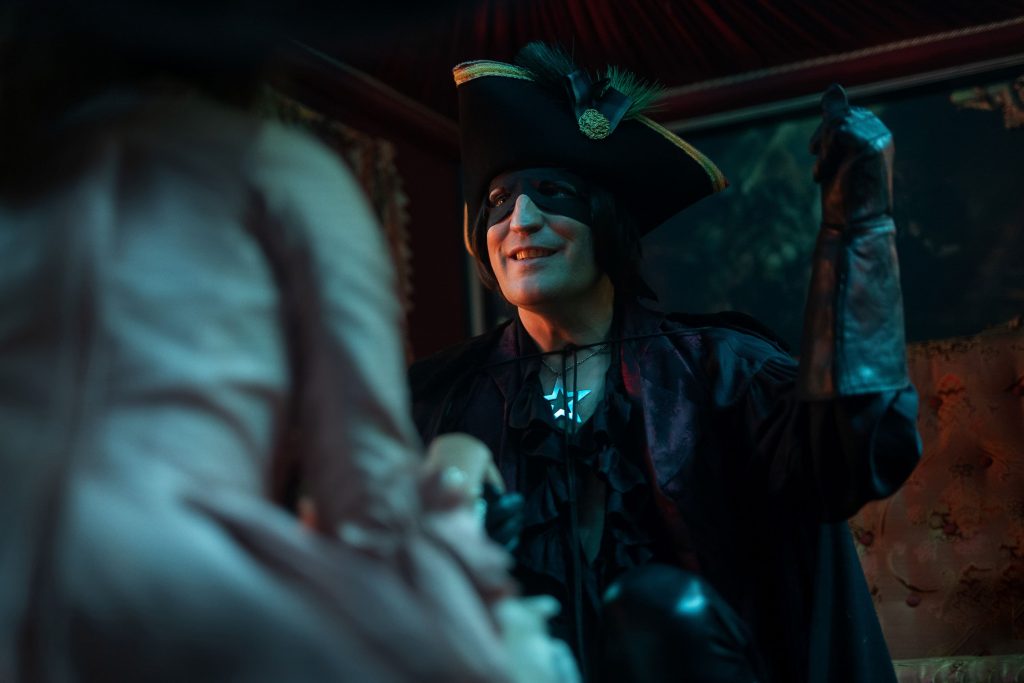
A great example of a visual text that poses these questions in a counterfactual and metafictional biofiction format is the mini-series The Completely Made-Up Adventures of Dick Turpin, which premiered in March 2024 on Apple TV+. Starring Noel Fielding as Dick Turpin (1705-1739), the show presents the story of Britain’s most famous highwayman as an absurdist period comedy. Turpin’s exploits have been fictionalized and romanticized even before his execution in 1739, fuelled by sensational reports in the Newgate Calendar. This trend gained momentum in the 19th century with the publication of William Harrison Ainsworth’s Newgate novel Rockwood (1834) and penny dreadfuls like Edward Viles’s Black Bess: The Knight of the Road (1886). These texts portray Turpin as a dandy highwayman, a romantic lover, and a Robin Hood-like folk hero. In the 20th century, his legacy continued with the Dick Turpin Library, a series of pulp fiction novels published by Aldine Press (1903-1907), Triller Picture Library comic books in the 1950s, and multiple feature films and television series, including the British drama Dick Turpin (1979-1982), starring Richard O’Sullivan in the eponymous role. The popularity of swashbuckling heroes like Turpin among teenagers in the 1920s and 1930s is indicated by collectibles featuring highwaymen and pirates, such as cigarette cards (Hagger 36-40). Other depictions of Dick Turpin as a dandy highwayman include Adam and the Ants’ song Stand & Deliver (1982) and its parody in the Horrible Histories television series, Dick Turpin, Highwayman (2011), sung by Mat Baynton.
Apple TV+’s show incorporates some of these popular representations; for instance, the opening credits feature a song that proclaims, “Stand and deliver, your money or your life”. This is contrasted with a parodic visual depiction of Dick Turpin, who is shown sitting on a pony, holding a tiny pistol in one hand and some knitting in the other. In the Apple TV+ series, Dick Turpin is portrayed as a quirky character: the son of a butcher, he is a vegan seeking a different path for himself. He leaves home with a sewing machine and a pair of purple shoes under his arm. His special skills include sewing, knitting, and everything related to fashion. By a twist of fate, the Essex Gang offers him the chance to become their leader, which he eagerly accepts because it comes with the promise of cool clothes and a cape. The first thing he does is design new costumes for the gang, and these skills often save him and the gang from trouble.
The series’ comedic tone is rooted in the metafictional contrast between myth and “real” history – though, in reality, only one episode contains references to actual historical events. After being saved from the noose by the gang, Dick Turpin’s subsequent adventures are “completely made-up”, as the title suggests, yet they also resemble episodes from pulp novels and comics from the Thriller Library. For instance, episode 2 features the robbery of a cursed carriage, while episode 4 depicts a battle with a witch. Thus, the show grapples not so much with historical records as with popular mythology.
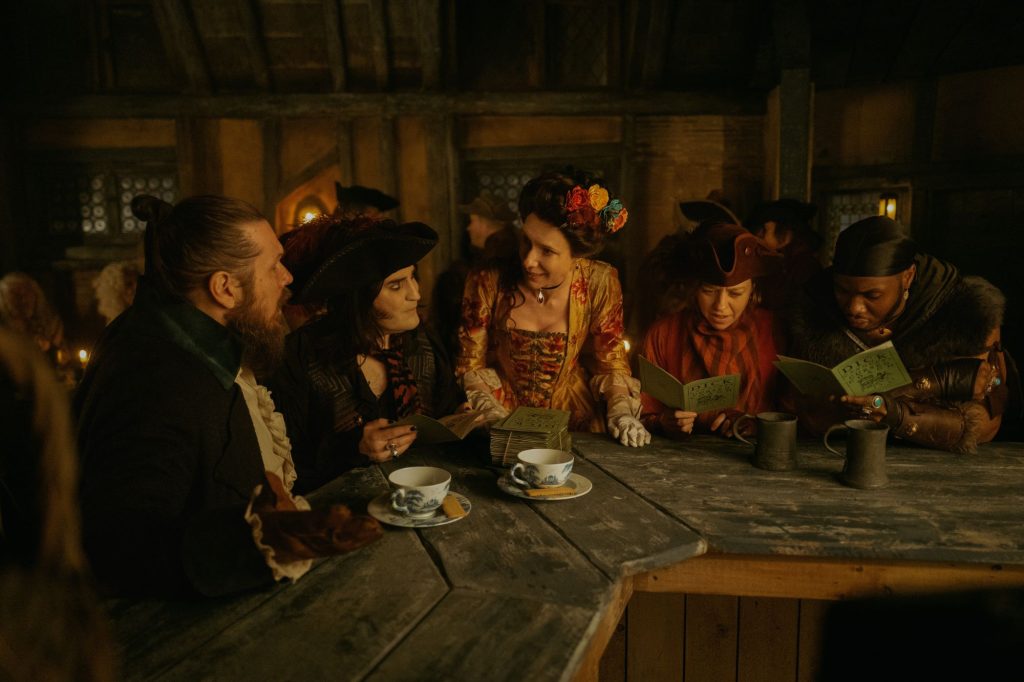
One example of the show metafictionally addressing the myth of Dick Turpin occurs in the first episode, where we meet Turpin on his way to the gallows. While the prisoners stop at an inn to rest, they encounter Eliza Bean (Dolly Wells) – the author of the pamphlets, later responsible for building the legend of Dick Turpin. Dick recounts his adventures, including the accidental death of the previous leader of the Essex gang, Tom King. We witness the events: Tom forces Dick to help rob a carriage, but the carriage breaks down, causing Dick to fall out. The bag containing the pistol lands on a nearby tree branch, then falls onto King’s head, killing him. However, the gang views Dick as a brave saviour from their tyrannical chief and appoints him the new leader, which displeases Nell (Ellie White), who believes she should assume the role. When Dick finishes his story, Eliza summarizes it this way:
[Eliza] “Turpin, with his magnificent head of raven hair, emerges from the upended carriage, coming face-to-face with the incandescent Tom King. Then, without one thought for his own self, Dick Turpin bravely and heroically shoots Tom King in the face. Dick beguiles the gang to take his place as the new rightful leader. Bewitching Honesty, wrestling Moose to the ground and seducing Nell, who was clearly in love with him from the beginning.” Right?
[Turpin] I mean, yeah, loosely.
This scene metafictionally comments on the authenticity of historical documents, which do not record a historical fact as much as show how that fact was perceived and preserved. It directly pokes fun at the Dick Turpin mythos in popular culture. It also critiques contemporary media, exploring how the general populace’s perspective on events is shaped by media coverage.
The show’s antagonist – the Nemesis of Dick Turpin and the Essex gang – is Jonathan Wilde (Hugh Bonneville), a historical figure who serves as both a thief-taker and a criminal, receiving protection money from King’s gang. He is frequently accompanied by his 12-year-old son, Christopher (Samuel Leakey), who has no one to care for him due to the absence of a nanny. However, Wilde lacks time for Christopher because “Daddy’s doing business”, often shushing him, which provides comedic moments. In episode 3, by coincidence, Christopher spends a day in London with the Essex Gang. He is fascinated by them and even creates his own trading cards featuring the gang members, which is a reference to the aforementioned cigarette cards popular among teenagers in 1930s. He befriends a gang member named Moose, who serves as a positive male role model for the boy (contrary to what his father tells him about thugs). This episode offers a metafictional rebuttal to the criticism of popular culture, which is often accused of undermining values and corrupting youth by glorifying criminals. Instead, it reflects on how popular culture can sometimes compensate for a lack of parental attention while still holding onto some ideals.
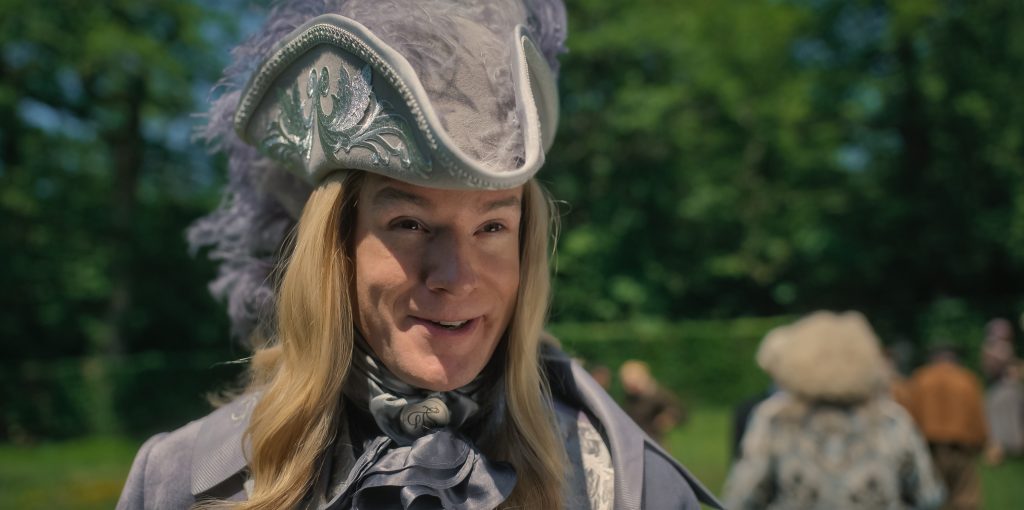
The final example of metafictional commentary in the show is found in episodes 5 and 6, which feature Tommy Silversides (Connor Swindells), a rival highwayman. Episode 5 opens with a scene where tourists are guided through Epping Forest, hoping to be robbed by the famous Turpin, an anachronistic allusion to the phenomenon of “dark tourism”. However, Turpin is preoccupied with signing pamphlets, allowing Tommy Silversides and his gang to sweep the tourists off their feet with their looks and stunts. Silversides is the quintessential dandy highwayman: handsome, elegantly dressed, performing acrobatic tricks, agile, charming, and witty. He seduces both women and men, accompanied by a chorus that praises his remarkable skills and charisma. Silversides embodies everything Dick Turpin is, but better – he sews better, knits better, and even wins a contest for the most beautifully tousled hair.
Tommy takes over the Essex Gang and begins his authoritarian rule in Hempstead. However, Silversides is revealed to be a façade – an actor planted by the Crime Syndicate. His incredible feats are performed by a stunt double, and his stunning hair is a wig. Silversides represents the romanticized vision of the outlaw from 1970s and 1980s swashbuckling films, but beneath the charming exterior lies an actor and a political dictator. This character not only provides metafictional commentary on the performativity and kitschiness of the romanticized movie bandit and artificially manufactured celebrities, but also offers a political critique of populist politics, which seduces the public with tricks and charming performances, only to strip away their freedoms once the community is won over.
Based on the above observations, we can conclude that the series does not aim to demythologize Dick Turpin. The show’s completely absurd and purely fictional adventures are not intended to debunk existing myths. Rather, the series seeks to explore the mechanisms of mythologization and its effects through metafictional referentiality. The examples discussed reflect the evolution of the Turpin legend, from pamphlets to popular culture and films. This anachronistic and metafictional historical comedy provides commentary on the media’s role in constructing a biographical legend, its influence on youth, and the manipulation of popular media representations.
Works cited:
Hagger, Alasdair. “Dick Turpin: The Pre-Postmodern Outlaw.” New Vistasvol. 6 no. 2, 2020, pp. 35-40.
Kohlke, Marie-Luise, and Christian Gutleben. “Taking Biofictional Liberties: Tactical Games and Gambits with Nineteenth-Century Lives.” Neo-Victorian Biofiction: Reimagining Nineteenth-Century Historical Subjects, edited by Marie-Luise Kohlke and Christian Gutleben, Brill/Rodopi, 2020, pp. 1–53.
Lackey, Michael. “Introduction: A Narrative Space of Its Own.” Biographical Fiction: A Reader, edited by Michael Lackey, Bloomsbury Academic USA, 2017, pp. 1–15.
LaRocca, David. “Introduction: An Invitation to the Varieties and Virtues of ‘Meta-ness’ in the Art and Culture of Film.” Metacinema: The Form and Content of Filmic Reference and Reflexivity, edited by David LaRocca, OUP, 2021, pp. 1-28.
Nünning, Ansgar. “Fictional Metabiographies and Metautobiographies: Towards a Definition, Typology and Anlysis of Self-Reflexive Hybrid Metagenres.” Self-Reflexivity in Literature, edited by Werner Huber, Martin Middeke, and Hubert Zapf, Könninghausen and Neumann, 2005, pp. 195-210
Ní Dhúill, Caitríona. Metabiography: Reflecting on Biography. Palgrave Macmillan, 2020.
Waugh, Patricia. Metafiction: The Theory and Practice of Self-Conscious Fiction. Routledge, 1984.