text by Magdalena Pypeć
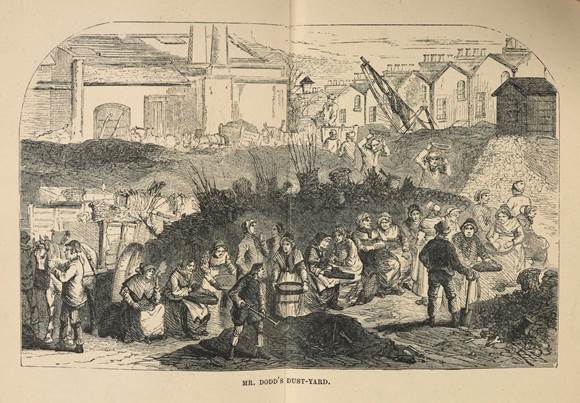
Old Harmon in Dickens’s Our Mutual Friend amassed an enormous fortune as a dust contractor, as one of the characters explains: “On his own small estate the growling old vagabond threw up his own mountain range, like an old volcano, and its geological formation was Dust. Coal-dust, vegetable-dust, bone-dust, crockery-dust, rough dust and sifted dust – all manner of Dust” (24; bk. 1, ch. II). The story behind Old Harmon’s wealth was not merely a figment of Dickens’s imagination but an example of the lucrative nineteenth‑century dust trade. In light of today’s emphasis on sustainable living and waste reduction, it is worth highlighting that the Victorians were remarkably effective recyclers; a striking example of this fact is the profitable business they made of processing and reusing household refuse. The mounds of detritus had substantial monetary value; they were sifted and segregated into various categories of resources, which were then resold and reused (see Figure 1).
“I’m a pretty fair scholar in dust. I can prize the Mounds to a fraction, and I know how they can be disposed of,” declares Old Harmon’s chief legatee, known in the novel as “the Golden Dustman” (186; bk. 1, ch. XV). As the article “Dust; or Ugliness Redeemed”, published in Household Words on 13 July 1850, explains, every organic, mineral, metallic, and textile material was channelled into a specific trade: agriculture, brickmaking, road building, papermaking, soap boiling, metalworking, glass recycling, or domestic fuel. Nothing was without potential value:
… the largest and best of the cinders are sold to laundresses, or to braziers … [Laundresses needed heat for boiling laundry and heating irons. Braziers were craftsmen who heated, soldered, or shaped small metal items]; and the next sort of cinders, called the breeze, because it is left after the wind has blown the finer cinders through an upright sieve, is sold to the brickmakers. … Two other departments, called the “soft-ware” and the “hard-ware,” are very important. The former includes all vegetable and animal matters — everything that will decompose. These are selected and bagged at once, and carried off as soon as possible, to be sold as manure for ploughed land, wheat, barley, &c. … The “hard-ware” includes all broken pottery, — pans, crockery, earthenware, oyster-shells, &c., which are sold to make new roads. “The bones” are selected with care, and sold to the soap-boiler. … Of “rags,” the woollen rags are bagged and sent off for hop-manure; the white linen rags are washed, and sold to make paper, &c. … the detached pieces of tin are then sold to be melted up with old iron, &c. Bits of old brass, lead, &c., are sold to be melted up separately, or in the mixture of ores. All broken glass vessels, as cruets, mustard-pots, tumblers, wine-glasses, bottles, &c., are sold to the old-glass shops. As for any articles of jewellery, — silver spoons, forks, thimbles, or other plate and valuables, they are pocketed off-hand by the first finder. Coins of gold and silver are often found, and many “coppers.” (Horne 380; emphasis in original)
Henry Mayhew’s account of the dust economy portrays the mound‑yard as alive with labour: “Among these heaps are many women and old men with sieves made of iron, all busily engaged in separating ‘brieze’ from the ‘soil’” (London Labour and the London Poor , vol. 2; see Figure 2). The Victorian dust‑heap was therefore a significant site of resource recovery well before the term ‘recycling’ existed. It entered both the physical landscape of London’s outskirts and the imaginative landscape of Victorian fiction.
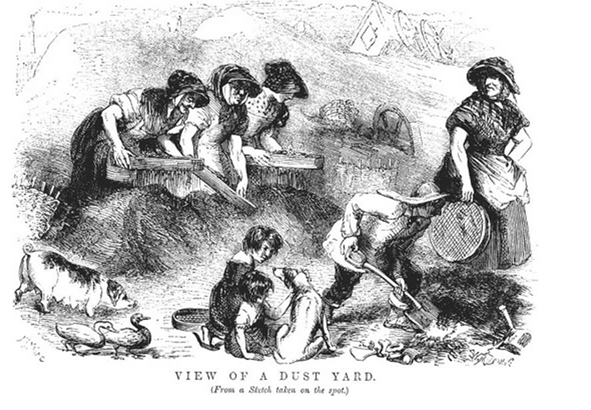
Henry Mayhew, London Labour and the London Poor, vol. 2
Works Cited
Dickens, Charles. Our Mutual Friend. Penguin Classics, 1997.
“The Dust‑Heaps at Mr. Dodd’s Dust‑Yard, London.” The Penny Illustrated Paper, 27 Jan. 1866. London Museum, https://www.londonmuseum.org.uk/collections/v/object-795045/mr-dodds-dust-yard/. Public domain.
Horne, R. H. “Dust; or Ugliness Redeemed.” Household Words, vol. 2, no. 37, 13 July 1850, pp. 379–384. Dickens Journals Online, University of Buckingham, https://www.djo.org.uk/indexes/articles/dust-or-ugliness-redeemed.html.
Mayhew, Henry. London Labour and the London Poor. Vol. 2, Project Gutenberg, 1861, https://www.gutenberg.org/files/60440/60440-h/60440-h.htm. Public domain.